SVG DOM & JavaScript API Glossary: 45+ Methods, Interfaces & Geometry Types
The Definitive Reference for Scripted Vector Graphics: When manipulating SVG in JavaScript — whether building interactive dashboards, chart visualizations, path stroke animations, or pan-and-zoom viewports — developers rely on the W3C SVG DOM specification. This exhaustive technical glossary catalogs 45+ methods, interfaces, matrix algorithms, and geometry types:
- Interactive Real-Time Filter: Search across all 45+ terms instantly by name, keyword, or interface category.
- W3C Interface Mapping: Exact method signatures, parameter types, return values, and browser compatibility notes.
- Coordinate Matrix Algorithms: Converting client screen pixels to viewBox coordinates with
getScreenCTM()andDOMMatrix. - Path Measurement & Motion: Calculating exact arc lengths and drawing trajectories with
getTotalLength()andgetPointAtLength().
No SVG DOM terms matching your query.
1. Coordinate Systems, Matrices & Transformations
Returns the Current Transformation Matrix (CTM) mapping local SVG user coordinates directly to device screen pixels. Invaluable for mapping client pointer events (e.clientX, e.clientY) to exact vector coordinates.
const ctm = svgElement.getScreenCTM();
const pt = new DOMPoint(event.clientX, event.clientY);
const svgCoords = pt.matrixTransform(ctm.inverse());
console.log(`X: ${svgCoords.x}, Y: ${svgCoords.y}`);Returns the transformation matrix mapping local element coordinate space to its nearest ancestor viewport coordinate space (typically the root <svg>).
const localMatrix = childGroup.getCTM();
console.log(`Scale X: ${localMatrix.a}, Translate X: ${localMatrix.e}`);Modern web standard representing 2D and 3D affine transformation matrices. Supports hardware-accelerated matrix multiplication, inversion, translation, and rotation.
const matrix = new DOMMatrix()
  .translate(100, 50)
  .rotate(45)
  .scale(1.5);
element.style.transform = matrix.toString();Represents an immutable or mutable 2D/3D coordinate vector (x, y, z, w). Replaces legacy svg.createSVGPoint() in modern browsers.
const pt = new DOMPoint(24, 48);
const transformed = pt.matrixTransform(matrix);Creates a detached SVGPoint initialized at (0, 0). While supported in all browsers, new DOMPoint() is preferred in modern codebases.
const pt = svg.createSVGPoint();
pt.x = mouseX;
pt.y = mouseY;Multiplies the point coordinates by a specified 2D/3D matrix, returning a new transformed point object.
const localPoint = screenPoint.matrixTransform(svg.getScreenCTM().inverse());A sequence of SVGTransform items governing an element's transform attribute. Provides indexed item access and methods like appendItem() and consolidate().
const transformList = element.transform.baseVal;
const translateTransform = svg.createSVGTransform();
translateTransform.setTranslate(20, 40);
transformList.appendItem(translateTransform);Creates an SVGTransform object wrapping an existing affine matrix.
const transform = svg.createSVGTransformFromMatrix(customDOMMatrix);
element.transform.baseVal.initialize(transform);
2. Geometry, Bounding Boxes & Path Measurement
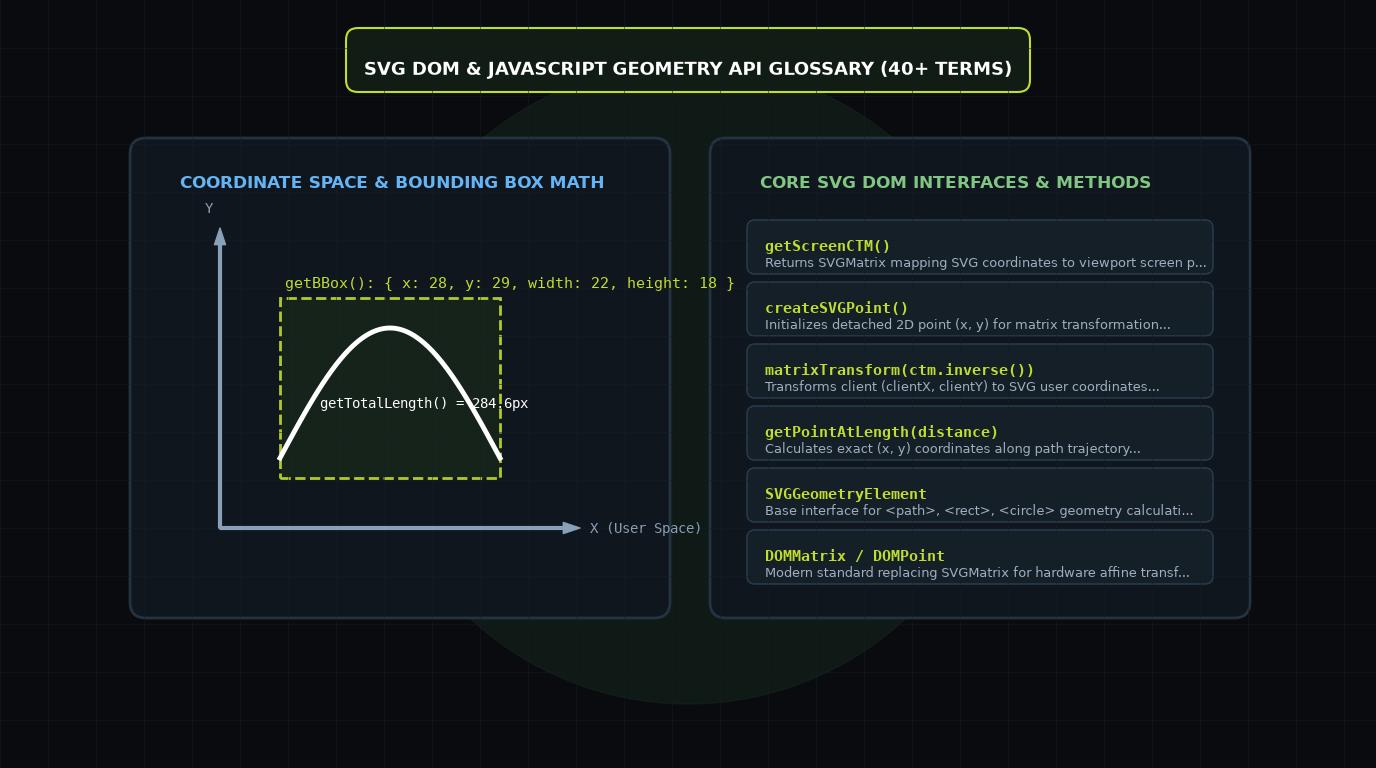
Computes the tight bounding box containing the element's rendered geometry in current user coordinate space. Ignores external CSS transforms and stroke width by default.
const bbox = pathElement.getBBox();
console.log(`x: ${bbox.x}, y: ${bbox.y}, width: ${bbox.width}, height: ${bbox.height}`);Returns the total path length in user space units. Fundamental for CSS path drawing animations using stroke-dasharray and stroke-dashoffset.
const length = path.getTotalLength();
path.style.strokeDasharray = `${length}`;
path.style.strokeDashoffset = `${length}`;Calculates the (x, y) coordinates along a path trajectory at a specified distance from the origin. Used for particle path follow animations and motion path positioning.
const midPoint = path.getPointAtLength(length * 0.5);
marker.setAttribute('cx', midPoint.x);
marker.setAttribute('cy', midPoint.y);Determines whether a DOMPoint or user-space coordinate is inside the element's filled shape area according to its fill-rule.
const isHit = shape.isPointInFill(new DOMPoint(120, 85));Determines whether a point falls within the stroke width outline of the geometry element.
const onBorder = shape.isPointInStroke(new DOMPoint(120, 85));The abstract base interface for all SVG shape elements that have a geometric outline. Exposes getTotalLength(), getPointAtLength(), and hit-testing methods.
Reflects the author-defined pathLength attribute, allowing manual calibration of stroke dash calculations.
path.pathLength.baseVal = 100; // Calibrate path to 0-100 scale3. Document Structure & Root SVGSVGElement APIs
The DOM interface for root <svg> elements, providing viewport control, animation state, and matrix instantiation factories.
Provides direct read/write access to the root element's viewBox min-x, min-y, width, and height values.
const vb = svg.viewBox.baseVal;
vb.x -= 10; // Pan left
vb.width *= 1.1; // Zoom outGets or sets the current zoom factor applied to the root SVG canvas.
svg.currentScale = 2.0; // Zoom canvas to 200%Gets or sets the current panning translation coordinates on the root SVG viewport.
svg.currentTranslate.x += 25;
svg.currentTranslate.y += 10;Governs how the SVG graphic aligns and scales when aspect ratios differ between viewBox and container.
svg.preserveAspectRatio.baseVal.align = SVGPreserveAspectRatio.SVG_PRESERVEASPECTRATIO_XMIDYMID;4. Animation & Timeline Control
Suspends all SMIL animations (e.g. <animate>, <animateTransform>) running within the SVG fragment.
svg.pauseAnimations();Resumes SMIL animations from their current paused offsets.
svg.unpauseAnimations();Returns true if SMIL animations are currently suspended in the document.
if (svg.animationsPaused()) svg.unpauseAnimations();Returns the elapsed animation timeline time in seconds since SVG document initialization.
const elapsed = svg.getCurrentTime();Scrubs the SMIL animation timeline to an exact timestamp, updating all animated vectors immediately.
svg.setCurrentTime(2.5); // Seek to 2.5 secondsFrequently Asked Questions
What is the difference between getBBox() and getBoundingClientRect() on SVG elements?
getBBox() returns the tight bounding rectangle in the local SVG user coordinate space before any transforms, CSS styling, or viewport scrolling are applied. getBoundingClientRect() returns the element's rendered pixel dimensions and position in screen window coordinates, including all applied CSS transforms and page scroll offsets.
How do I convert a mouse click (clientX, clientY) into SVG coordinates?
Use the SVG's getScreenCTM() inverse matrix: instantiate an SVGPoint or DOMPoint with (e.clientX, e.clientY), then call pt.matrixTransform(svg.getScreenCTM().inverse()). This accurately maps screen pixels back into the SVG's internal viewBox user coordinate space regardless of responsive scaling.
Why is getTotalLength() only available on SVGGeometryElement elements?
getTotalLength() requires defined geometric path trajectories. It is implemented on SVGGeometryElement subclasses (
Is SVGMatrix deprecated in modern web browsers?
Yes. The W3C Geometry Interfaces Module Level 1 deprecated SVGMatrix in favor of DOMMatrix. Modern browsers return a DOMMatrix object from getScreenCTM() and getCTM(), which maintains backwards compatibility with SVGMatrix properties (a, b, c, d, e, f) while adding support for 3D hardware matrix operations.
How does pathLength differ from getTotalLength()?
getTotalLength() is a DOM JavaScript method returning the computed geometric path distance in actual user units (e.g., 284.6px). The pathLength attribute is an author-defined calibration value (e.g., pathLength='1') that normalizes stroke-dasharray and stroke-dashoffset percentages regardless of physical dimensions.